Pax Autocratica does not have one weapon that is best in every expedition. A useful choice depends on range, target density, movement, ammunition pressure, Weapon Cores, Combination Cores, squad support, and the current patch. Build 24747486 also changed two Core options, so a ranking made before AG-14 may no longer describe the same loadout.
What Best Means in This Build
Begin with the job the weapon must perform. A close-range option can clear ordinary targets quickly while becoming dangerous against an enemy that controls space. A long-range weapon can create safe damage but struggle when several fast targets enter the player's minimum comfortable distance. A launcher may dominate clustered enemies while wasting ammunition on isolated threats. A weapon that feels weak alone may become the correct choice when its Cores solve a specific problem.
Replace the word "best" with a measurable question:
- Which weapon removes a priority target with the least exposure?
- Which loadout controls a group without emptying reserves too early?
- Which option stays reliable when the desired Core does not appear?
- Which weapon complements the current squad rather than duplicating it?
- Which choice remains manageable during a Boss phase or dense projectile pattern?
These questions produce a loadout decision. A universal letter grade hides the conditions that made the result possible.
Choose a Weapon Role
Fast pistols and submachine guns tend to support mobile, close-to-medium engagements. Rifles offer a more general profile when the route is unknown. Sniper-style weapons reward clear sight lines and deliberate target selection. Shotgun-like options trade reach for immediate close pressure. Launchers and unusual heavy weapons can control groups or deliver bursts, but their handling and resource cost matter. Bows, crossbows, organic weapons, and melee tools introduce different timing and risk patterns.
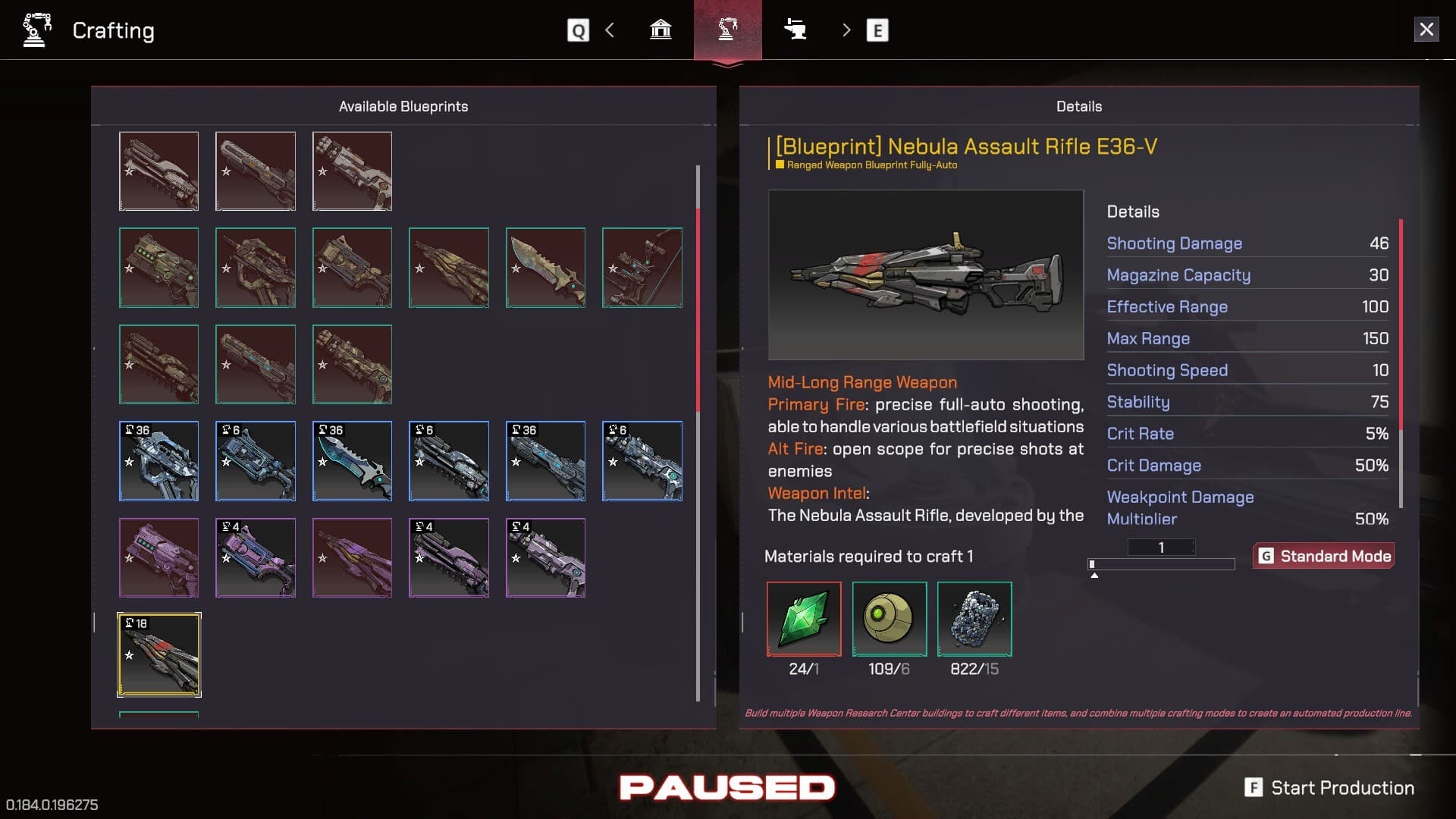
The current game's visible arsenal includes conventional and stranger options across those families. Names shown in recent play include the Nebula Pistol E18, NAT SMG E9, Nebula Assault Rifle E36, Recon Sniper, Grenade Launcher E54, Frostfire Twin-Core Launcher, Gauss Pulse Cannon, Bioplasma Shotgun, Mutant Acid Spitter, Starfire Bowblaster E27, Gratov Quantum Longbow, Darkcore Dagger, and Wraithstep Chainsaw. Treat this as a field catalog rather than a promise that every item appears at the same stage or quality.
Pick a primary role and a failure case. For example, a precision loadout needs an answer when enemies close distance. A crowd-control loadout needs an answer for a durable isolated target. That answer can come from the second weapon, movement, a Core interaction, an ability, or the deployed squad.
Judge the Whole Loadout
Weapon Cores can change how a gun behaves, so the name on the weapon is only the beginning of the comparison. Combination Cores can reward a set of effects that would look ordinary in isolation. The player's armor, supplies, movement comfort, and squad also change how long a loadout can operate safely.
Evaluate at least six dimensions:
| Dimension | What to watch |
|---|---|
| Single-target pressure | Time and exposure needed to remove a durable target |
| Group control | Ability to stagger, zone, pierce, chain, or damage clustered enemies |
| Range | Distance where aim, projectile behavior, and safety remain dependable |
| Mobility | How easily the player can fire while repositioning |
| Ammo pressure | How quickly the loadout consumes resources during a normal sector |
| Core dependence | Whether performance collapses without one rare interaction |
A stable weapon is not always the one with the highest visible burst. Reliability across ordinary rooms can preserve supplies and health for the encounter that matters. Conversely, a specialized weapon can be the better choice when the expedition objective is known and its weakness is covered.
Current Core Changes
AG-14 increased the damage of Weapon Core - Vortex Shell and expanded the damage area of Weapon Core - Thunderbolt Arrow. These changes matter because they alter both direct output and how easily the effect connects with multiple targets. Any pre-AG-14 comparison involving those Cores needs to be treated as historical.
The patch note does not establish an overall winner. It does not hold weapon quality, difficulty, target defense, Core level, or the rest of the build constant. It tells you which interactions deserve a new test. Vortex Shell should be retested for single-target and mixed-pack performance. Thunderbolt Arrow should be retested for coverage, positioning tolerance, and whether the larger area changes the value of grouping enemies.
Avoid converting a balance note into a damage number that is not displayed in the current game. The direction of the change is known; the exact practical advantage depends on the loadout and encounter.
A Repeatable Test Method
Good comparisons remove variables. Use the same difficulty, sector, weapon quality, upgrade state, squad allocation, and starting resources. Record the Build ID. If Core choice is the variable, keep the base weapon and other Cores stable. If the weapon is the variable, compare without changing three supporting systems at the same time.
Run more than one encounter. A single favorable room can exaggerate an area weapon, while one open arena can flatter long range. Note time to remove the priority target, damage taken, ammunition remaining, downs or revives, and whether the weapon forced unsafe positioning. A short written record is more useful than a confident memory after several runs.
When a test cannot hold those conditions, label the result as a practical impression. It can still guide the next experiment, but it should not become an exact DPS claim or a permanent tier placement.
Practical Loadout Rules
Carry an answer for both ordinary groups and a durable target. Favor a familiar handling pattern when learning a new sector. Do not build around a rare Core unless the fallback weapon remains functional without it. Let the squad cover a weakness instead of duplicating the player's strongest role. Recheck any favorite after a balance patch changes its Core or damage area.
Before departure, ask whether the loadout can survive a long room, a close ambush, an open fight, and a resource shortage. If one answer is no, decide how movement, the second weapon, supplies, or soldiers will cover it. That process produces a better "best weapon" decision than a tier list copied from a different build.
The current public material does not provide a controlled, same-build comparison for every weapon. For that reason, this page offers roles and a test method rather than an invented S-to-C ranking. Use it to narrow choices, then judge the result in the expedition conditions that match your run.